Mounjaro Side Effects: Upper Abdominal & Back Pain?
CK 3446 Created at
700
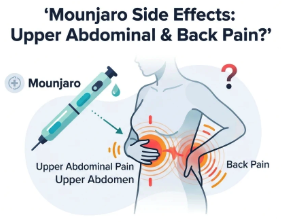
In the early stages of Mounjaro administration, digestive side effects such as nausea or upper abdominal discomfort commonly occur and mostly subside over time, whereas pancreatitis differs in that it causes severe, persistent pain in the upper abdomen that often radiates to the back. If upper abdominal pain gradually worsens or is accompanied by back pain, it could be a sign of a serious side effect such as pancreatitis, so you must immediately visit an emergency room or a nearby medical facility for care. Furthermore, if symptoms have not clearly resolved or pancreatitis is suspected, it is advisable for your safety to delay the next scheduled injection until you consult with a healthcare provider to determine whether to resume treatment.
Peak Drug Concentration and Timing
Day 2 following a Mounjaro injection represents the period when plasma concentration of tirzepatide reaches its peak levels (Tmax). Because circulating drug levels are at their highest during this 24 to 48-hour window, gastrointestinal (GI) side effects are most prevalent and intense during this timeframe.
Pharmacological Mechanisms
Tirzepatide is a dual glucose-dependent insulinotropic polypeptide (GIP) and glucagon-like peptide-1 (GLP-1) receptor agonist. Its primary mechanisms of action include:
Delayed Gastric Emptying: It significantly slows the rate at which the stomach contents empty into the small intestine, leading to prolonged gastric distension.
Central Appetite Suppression: It acts directly on the central nervous system (specifically the hypothalamus) to reduce hunger and increase satiety signals.
This rapid alteration in gastrointestinal motility and neural signaling causes a temporary mismatch in normal digestive rhythms, manifesting as localized GI distress.
Typical Clinical Trajectory
Symptom Profile: Patients commonly experience mild to moderate nausea, epigastric fullness, bloating, early satiety, belching, and heartburn/acid reflux.
Resolution: In most individuals, these symptoms peak within the first 48 hours post-dose and gradually abate over a few days as the gastrointestinal tract adapts to the medication. As treatment continues over several weeks, the body typically develops tolerance, reducing the severity of these early symptoms.
Differentiating Common GI Side Effects from Acute Pancreatitis
Distinguishing between transient, expected gastrointestinal side effects and acute pancreatitis—a rare but severe adverse event associated with incretin-based therapies—is critical for patient safety.
Feature
Common GI Side Effects (Benign / Expected)
Acute Pancreatitis (Emergency Red Flag)
Pain Intensity
Mild to moderate; dull ache, feeling of indigestion, heavy fullness, or transient cramping.
Severe, intense, knife-like, or stabbing pain; often incapacitating and renders daily activities impossible.
Pain Pattern
Intermittent (comes and goes); tends to fluctuate with food intake; gradually improves over time or with over-the-counter antacids/digestive aids.
Continuous, unrelenting, and progressively worsening over hours without spontaneous relief.
Effect of Posture
Minimal change with body position adjustments; changing position or walking does not drastically alter the sensation.
Classically exacerbated when lying flat on the back (supine); partially relieved by bending forward or curling into a fetal position.
Associated Symptoms
Mild nausea, occasional dry heaving, burping, mild diarrhea, or constipation; absence of systemic inflammation signs.
Persistent, severe vomiting; high fever; chills; cold sweats; rapid heart rate (tachycardia); dizziness.
Back Pain as a Critical Warning Sign and Immediate Action Plan
Anatomical Basis of Radiation Pain
The pancreas is located deep within the upper abdomen in the retroperitoneal space, sitting directly in front of the spine. When acute inflammation of the pancreas occurs:
The resulting tissue swelling and chemical irritation stimulate visceral sensory nerve fibers.
This frequently leads to referred pain (radiating pain) that penetrates directly through the upper abdomen into the mid-to-lower back, and occasionally up toward the left shoulder.
Emergency Action Protocol
If a patient experiences a combination of severe upper abdominal pain, radiating back pain, and persistent nausea or vomiting:
Immediate Medical Evaluation: Go directly to an emergency department or urgent medical care center without delay.
Diagnostic Workup Required:
Blood Tests: Immediate measurement of pancreatic enzymes, specifically serum lipase and serum amylase (elevations of 3 times or more above the upper limit of normal strongly indicate acute pancreatitis), along with full blood counts and metabolic panels.
Diagnostic Imaging: Abdominal ultrasound or contrast-enhanced abdominal computed tomography (CT) to visualize pancreatic inflammation, peripancreatic fluid, or gallstones.
Protocol for Delaying or Modifying Subsequent Injections
Absolute Criteria for Withholding the Next Dose
The next scheduled injection of Mounjaro must be strictly withheld if a patient experiences unexplained, severe abdominal pain, persistent vomiting, or any signs indicative of acute pancreatitis, pending medical evaluation.
Rationale: Administering an additional dose of a long-acting dual GIP/GLP-1 agonist while the pancreas or gastrointestinal tract is acutely inflamed can cause rapid clinical deterioration and increase the risk of severe complications such as pancreatic necrosis or systemic inflammatory response syndrome (SIRS).
Key Information to Report to Healthcare Providers
When consulting a physician regarding severe symptoms, provide the following detailed history:
Onset & Duration: Exact date and time the pain began, and whether it has been constant or intermittent.
Pain Localization: Precise area of pain and whether it radiates to the back, ribs, or shoulders.
Oral Intake & Fluid Retention: Ability to tolerate liquids or solid food, and the exact frequency and nature of any vomiting episodes.
Dose History: The current dosage level, date of the last injection, and step-up schedule history.
Post-Evaluation Management Strategies
If Pancreatitis is Confirmed: Mounjaro must be permanently discontinued, and alternative non-incretin-based therapies must be initiated for diabetes or weight management.
If Severe Common Side Effects are Confirmed (Pancreatitis Ruled Out):
Dose Escalation Hold: The healthcare provider will likely pause the planned dose escalation and maintain the patient at the current lower dose until tolerance improves.
Interval Adjustment: The provider may temporarily extend the interval between injections (e.g., spacing doses slightly further apart) or temporarily withhold treatment until symptoms completely resolve before restarting at a lower, tolerated dose.