Navigating App Store Guideline 4.3(a): Key Pitfalls to Avoid and How It Differs from 4.3(b)
CK 3434 Created at Updated at
600
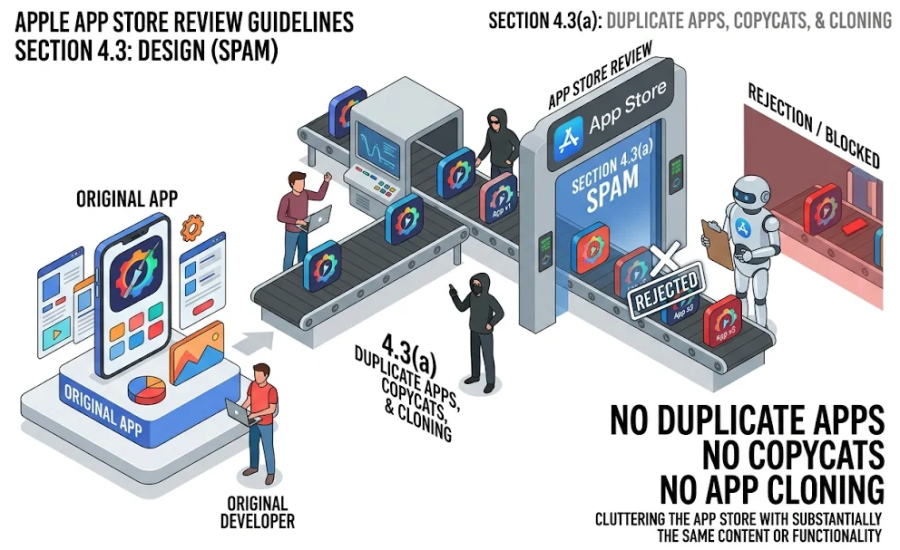
Apple App Store Review Guideline Section 4.3 falls under the Design category and specifically addresses Spam.
Section 4.3(a) focuses on duplicate apps, copycats, and app cloning. Apple enforces this rule to prevent developers from cluttering the App Store with multiple apps that offer substantially the same content, functionality, or design.
Core Requirements of 4.3(a)
No Duplicate Apps: You must not submit multiple versions of essentially the same app (e.g., separate apps for different cities, individual clients, or minor variations).
Consolidation: If your apps share a core codebase or utility, Apple expects you to combine them into a single "container" app (e.g., using in-app options or location switching to differentiate content).
Saturated Categories: Apple actively rejects generic apps in over-saturated categories (e.g., basic flashlights, fortune-telling apps, simple calculators, or basic quote apps) unless they offer unique, high-quality value.
Key Precautions to Avoid 4.3(a) Rejections
Developers must be particularly cautious when building client work, regional variations, or white-label solutions.
1. Avoid White-Labeling (Submitting the Same App for Different Clients)
The Risk: Creating an app for Client A and uploading an identical app (with just a logo/color change) for Client B under your account or separate accounts.
The Solution:
Combine services into one app and let users select their location/client within the app.
Alternatively, submit each white-labeled app strictly under the individual client's Developer Account, though Apple may still flag this if the codebase is identical.
2. Beware of App Builders and Templates
The Risk: Using automated app generators or standard commercial templates with minimal customization.
The Solution: Ensure your app has custom features, distinct UI/UX, and native functionality. Pure webview wrappers or template clones are quickly flagged.
3. Do Not Split Apps by Region, Language, or Minor Features
The Risk: Uploading "App Name - USA" and "App Name - Korea" as separate binaries.
The Solution: Use localization within a single app binary. Apple allows users to download one app that adapts based on the user's system language or region.
4. Changing Developer Accounts Will Not Bypass the Check
The Risk: Thinking that uploading duplicate apps under different developer accounts will hide the duplication.
The Reality: Apple uses automated scanning tools to analyze code signature, asset overlap, and architecture. If identical binaries are detected across different accounts, all linked accounts risk suspension.
Differences Between Section 4.3(a) and Section 4.3(b)
While both sections exist under the general "4.3 Spam" rule, they target completely different types of developer misconduct.
Feature
Section 4.3(a)
Section 4.3(b)
Primary Focus
App Duplication & Code Cloning
Store System & Metadata Manipulation
Target Object
The app's codebase, design, and functionality.
The app's App Store page, reviews, rankings, and metadata.
Core Issue
Uploading multiple apps that perform the exact same function.
Cheating the App Store algorithms or misleading users.
Main Violations
• White-label apps • Template clones • Separate apps for minor feature variations
• Keyword stuffing • Buying fake reviews or ratings • Manipulating top charts • Misleading pricing/in-app purchases
Detailed Breakdown of 4.3(b) (Spam Provision)
Section 4.3(b) is focused on integrity in marketing and store operations. It explicitly forbids developers from gaming the App Store discovery ecosystem:
Review & Rating Manipulation: Paying services to post positive reviews or downvote competitors.
Chart Manipulation: Artificially inflating download numbers to rank on the Top Charts.
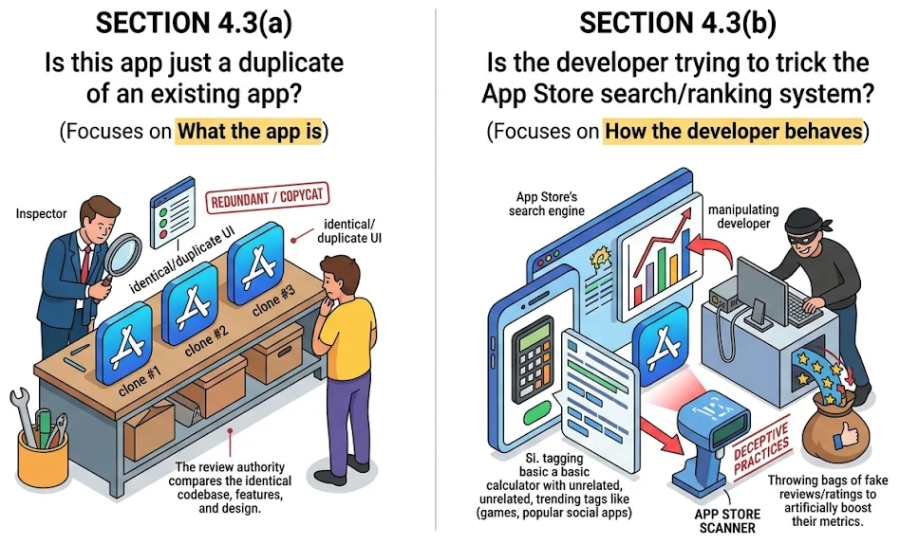
Metadata Spam: Adding unrelated trending keywords (e.g., adding popular game names to a calculator app's metadata) to gain unfair search visibility.
Deceptive Practices: Tricking users with misleading subscription prompts or hidden fees.
Summary of Distinction
4.3(a) asks: "Is this app just a duplicate of an existing app?" (Focuses on What the app is)
4.3(b) asks: "Is the developer trying to trick the App Store search/ranking system?" (Focuses on How the developer behaves)