Essential US Business Setup: Automated Payroll, Benefits, Tax Services, and Monthly Costs
CK 3414 Created at
700
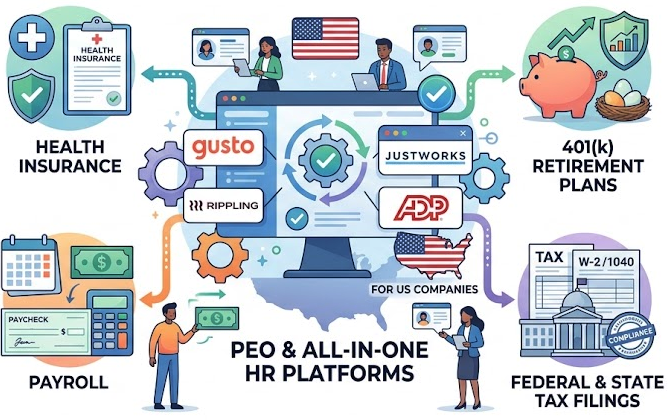
There are platforms and services known as Professional Employer Organizations (PEOs) and all-in-one HR platforms—such as Gusto, Rippling, Justworks, and ADP—that automate and manage employee health insurance, 401(k) retirement plans, payroll, and federal and state tax filings for companies operating in the United States.
These services handle full compliance, tax withholdings, and benefits administration on your behalf so you do not have to manage them manually. Monthly costs generally consist of a base service fee between 35 and 200 per month plus a per-employee fee ranging from 6 to150 per month, depending on whether you opt for a standard payroll and benefits software or a full-service PEO co-employment arrangement.
Essential Setup Requirements for US Companies
When establishing a business in the United States, managing payroll, employee benefits, and tax compliance requires specific administrative infrastructure.
1. Core Requirements Breakdown
A. Tax Processing & Payroll Compliance
Payroll Taxes: Employers must calculate, withhold, and deposit Federal Income Tax, Social Security tax, Medicare tax (FICA), and State/Local income taxes.
Federal & State Unemployment Taxes: Employers must pay FUTA (Federal Unemployment Tax Act) and SUTA (State Unemployment Tax Act).
Tax Filings: Regular filings of Form 941 (Quarterly Federal Tax Return), Form 940 (Annual Unemployment Tax), Form W-2 (Annual Wage Statement for employees), and Form 1099-NEC (for contractors).
B. Employee Insurance & Benefits
Mandatory Insurance:
Workers' Compensation Insurance: Protects employees in case of workplace injuries (required by law in almost all states).
State Disability Insurance (SDI): Mandatory in certain states (e.g., California, New York, New Jersey).
Voluntary/Competitive Benefits:
Health, Dental, & Vision Insurance: Major medical plans (typically tax-advantaged through Section 125 Cafeteria Plans).
Life & Disability Insurance: Short-term and long-term disability coverage.
C. Retirement Plans (401k)
Administration & Fiduciary Duties: Setting up a 401(k) plan requires plan design, employee enrollment, payroll integration, annual non-discrimination testing, and Form 5500 filings to comply with ERISA (Employee Retirement Income Security Act).
To handle these administrative burdens, US companies typically rely on two main categories of providers: Payroll/HR Software Solutions or Professional Employer Organizations (PEOs).
A. Payroll & HR Software (Direct Employers)
These platforms automate payroll processing, tax filings, software-driven benefits management, and compliance tools without altering your legal employment structure.
Gusto: Ideal for small businesses and startups. Handles payroll, tax filings, health insurance administration, and 401(k) integration seamlessly.
Rippling: Highly scalable HR and IT platform. Manages global payroll, US compliance, employee devices, and corporate benefits.
ADP Run / Paychex Flex: Traditional providers with modern cloud software, suitable for businesses needing standard corporate infrastructure.
B. Professional Employer Organizations (PEO / Co-Employment Model)
PEOs operate under a co-employment model. The PEO becomes the legal employer of record for tax purposes, aggregating employees from thousands of client companies to secure enterprise-grade health insurance rates and manage administrative compliance.
Justworks: A popular PEO for startups and SMBs offering simplified HR management, access to group health insurance, and full tax/workers' comp handling.
TriNet: High-end PEO tailored to specific industries (tech, finance, life sciences) providing rich enterprise benefit packages.
ADP TotalSource: Comprehensive PEO for larger or fast-growing teams needing extensive legal compliance support.
3. Cost Breakdown & Monthly Fees
Pricing typically follows a PEPM (Per Employee Per Month) model, often paired with a base monthly fee.
Solution Category
Service Examples
Estimated Pricing Model
Average Monthly Cost
Payroll/HR Software
Gusto, Rippling, ADP Run
Base Fee + PEPM
• Gusto: 40/mo base +6 to 12 per employee • Rippling: ~35/mo base + 8+ per employee • ADP Run: ~100–$200+/mo (custom quote)
PEO (Co-Employment)
Justworks, TriNet
Flat PEPM or % of Gross Payroll
• Justworks: $59 to 99 per employee/month • TriNet:100 to $200+ per employee/month • Percentage Model: 2% to 6% of gross payroll
Additional Cost Factors to Consider
401(k) Administration Fees:
Software platforms partner with 401(k) providers (e.g., Guideline, Human Interest).
Cost: Typically a $40–50 base fee/month + 4–$8 per participating employee/month.
Insurance Premiums (Health, Workers' Comp):
Premium costs are separate from platform fees.
Health Insurance: Employers usually cover 50–80% of employee premiums (averaging $500–$800+ per employee/month total policy cost).
Workers' Comp: Ranges from $0.25 to 2.00+ per100 of payroll, depending on job risk profiles.
State Tax Registration Services:
Opening a tax account in new US states when hiring remote workers usually incurs a one-time setup fee (50–200 per state) via third-party services or platform add-ons.
4. Platform Selection Strategy
For Early-Stage Startups (1–5 Employees):Gusto offers the lowest setup friction, low baseline fees, and easy built-in 401(k) integrations.
For Mid-Sized or Tech Startups Seeking High-End Benefits (5–50+ Employees): A PEO like Justworks allows small teams to access enterprise-tier health insurance plans that are normally unavailable to small companies.
For Companies with Remote IT & Global/US Distributed Teams:Rippling provides unified control over payroll, benefits, and device management.