India is the world's most populous country,with an estimated population exceeding 1.43 billion people (as of 2024).It is one of the most linguistically diverse nations globally,recognizing 22 official languages under the Eighth Schedule of the Indian Const...
India's Linguistic Landscape: Top Languages, Regional Distribution, and English Usage
CK 3398 Created at
1600
India is the world's most populous country, with an estimated population exceeding 1.43 billion people (as of 2024). It is one of the most linguistically diverse nations globally, recognizing 22 official languages under the Eighth Schedule of the Indian Constitution, while hundreds of other languages and thousands of dialects are spoken across its regions.
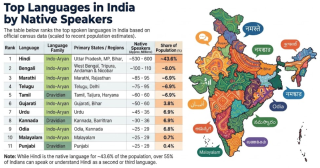
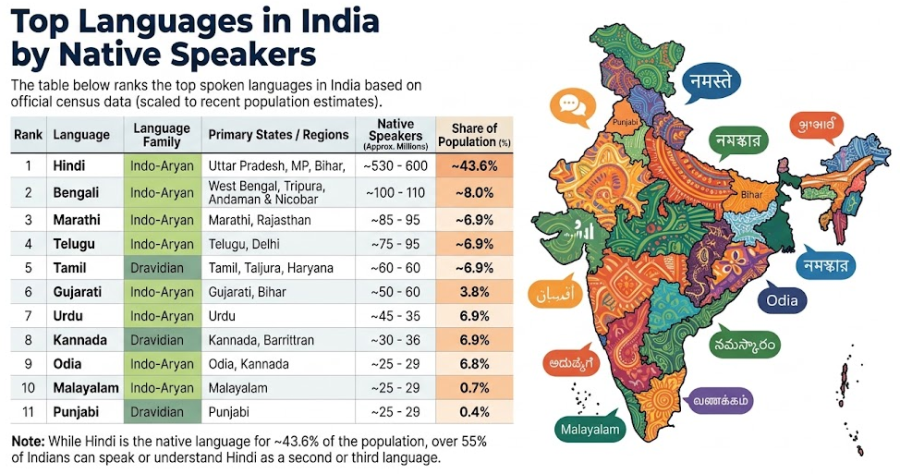
Top Languages in India by Native Speakers
The table below ranks the top spoken languages in India based on official census data (scaled to recent population estimates).
Note: While Hindi is the native language for ~43.6% of the population, over 55% of Indians can speak or understand Hindi as a second or third language.
Regional Language Distribution
India's languages are broadly divided into two major language families: Indo-Aryan (predominantly in the North, West, and East) and Dravidian (predominantly in the South).
No, English is not spoken by everyone in India. While English plays a crucial role in Indian society, its spread is limited by socio-economic factors, geography, and education levels.
Key Facts About English in India:
Percentage of Speakers:
Native Speakers: Less than 0.02% of the population considers English their mother tongue.
Total Proficiency: Approximately 10% to 12% of the total population (around 130–150 million people) can speak English with varying degrees of fluency, primarily as a second or third language.
Official Status:
English holds the status of an "Associate Official Language" alongside Hindi, which is the official language of the Union Government.
It is extensively used in the Supreme Court, legal proceedings, higher education, national media, corporate business, and technology sectors.
Demographic & Geographical Divide:
Urban vs. Rural: English fluency is heavily concentrated in major metropolitan cities (e.g., Bengaluru, Mumbai, Delhi, Chennai, Hyderabad). In rural areas, where over 60% of the population resides, English comprehension is very low.
North vs. South Divide: In South India, where non-Indo-Aryan languages are spoken, English is often preferred over Hindi as a neutral lingua franca for inter-state communication and administration.