| Microsoft and Qualcomm have announced their collaboration to bring on-device AI to Windows devices. This means that instead of relying on cloud-based AI, Windows devices will have AI chips built directly into them. This will make the Windows operating system more user-friendly and efficient. In the past, Steve Jobs and Bill Gates were the leaders of innovation in the tech industry. However, Steve Jobs passed away and Bill Gates stepped down from his position, leaving Elon Musk as the only one who can continue the legacy of innovation. On-device AI is a new approach to implementing AI technology. It allows for faster and more efficient processing of data, as well as increased privacy and security. This technology has the potential to revolutionize the way we use computers and other devices. "AI is becoming an essential part of our daily lives, and we need to ensure that it is accessible and easy to use for everyone," said Satya Nadella, CEO of Microsoft. "By partnering with Qualcomm, we can bring on-device AI to Windows devices, making them more powerful and efficient." This collaboration between Microsoft and Qualcomm is a significant step forward in the development of AI technology. It shows that the two companies are committed to pushing the boundaries of what is possible with AI and making it accessible to everyone. As we continue to see advancements in AI technology, it will be interesting to see how it will change the way we live and work. With the help of on-device AI, Windows devices will become even more powerful and versatile, opening up new opportunities for creativity and productivity. 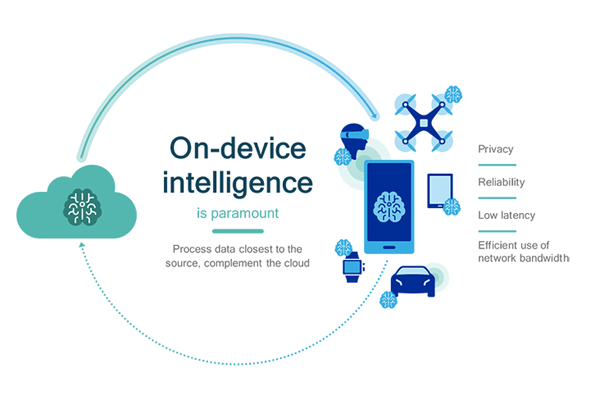
On-Device AI has several advantages over cloud-based AI, as it implements AI directly on the device itself rather than relying on the cloud. - Fast processing speed: Cloud-based AI may have a slower processing speed because it must transmit and process data on cloud servers. On-Device AI, on the other hand, processes data directly on the device, providing a faster processing speed.
- High security: Cloud-based AI may be vulnerable to security breaches because data is stored on external servers. On-Device AI, however, stores data internally, providing higher security.
- Privacy protection: Cloud-based AI may be vulnerable to privacy breaches because it stores user's personal information on external servers. On-Device AI, however, stores user's personal information internally, providing better privacy protection.
- Reduced power consumption: Cloud-based AI consumes a lot of power in the process of transmitting and processing data. On-Device AI, however, processes data internally, reducing power consumption.
- Improved user experience: On-Device AI can quickly respond to user requests because it processes data directly on the device, improving the user experience.
- Providing customized services: On-Device AI can collect and analyze user data to provide customized services, which can help increase user satisfaction.
- Applicable in various fields: On-Device AI can be used in various fields. For example, it can be used to recognize and process user voice commands on mobile devices such as smartphones, tablets, and laptops, and can also be used to recognize the surrounding environment and control driving in autonomous vehicles.
- Cost savings: Cloud-based AI incurs a lot of costs in transmitting and processing data. On-Device AI, however, can reduce costs by processing data internally.
- Overcoming geographical limitations: Cloud-based AI may have geographical limitations. For example, when using services overseas, data transmission speed may slow down or service usage may be limited. On-Device AI, however, has no geographical limitations and can be used anytime, anywhere.
- Improving data processing speed: On-Device AI processes data internally, which makes data processing speed faster. This allows for quick response to user requests and helps improve the quality of services.
|