If you've ever watched pay TV in Vietnam,you may have noticed something unusual: the ads are remarkably sparse.On a typical cable channel back home you might lose ten or fifteen minutes of every hour to commercials.In Vietnam,paid channels feel almost ad-f...
Why Does Vietnamese Cable TV Have Almost No Ads? A Look at the Rules
CK 3398 Created at
2,60200
If you've ever watched pay TV in Vietnam, you may have noticed something unusual: the ads are remarkably sparse. On a typical cable channel back home you might lose ten or fifteen minutes of every hour to commercials. In Vietnam, paid channels feel almost ad-free by comparison.
That isn't a coincidence, and it isn't because Vietnamese broadcasters are being generous. It's the law. And once you pull on that thread, you end up in a surprisingly interesting corner of media regulation that now reaches all the way to YouTube, Netflix, and the newest entrant on the scene: free ad-supported streaming TV, or FAST.
Here's how it all fits together.
The 5% Rule for Pay TV
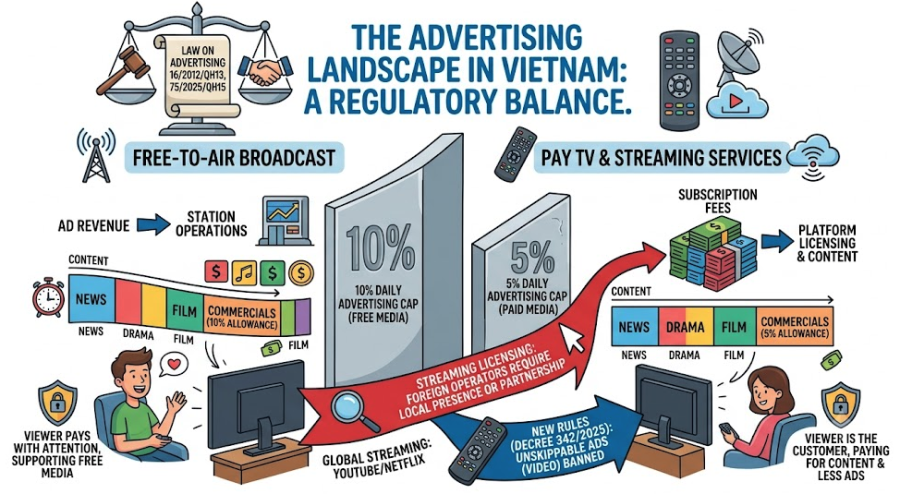
The starting point is Vietnam's Law on Advertising (No. 16/2012/QH13). Article 22 sets hard ceilings on how much advertising a broadcaster can run in a single day, and it treats free and paid channels very differently.
Free-to-air channels (think VTV and other channels run by licensed press agencies) can fill up to 10% of their total daily broadcast time with advertising.
Pay TV channels are capped at just 5% of total daily broadcast time.
So a paid channel gets exactly half the advertising allowance of a free one. There's an exception for dedicated advertising channels and programs — home-shopping channels, for instance, where the ads are the content — but for ordinary entertainment channels, the 5% cap is the rule.
The logic is straightforward and, honestly, fairly consumer-friendly. If you're already paying a subscription fee, the government doesn't want you paying again with your attention. Free broadcasting lives or dies on ad revenue, so it gets a more generous allowance. Paid channels, where the viewer is already the customer, get reined in.
There are mid-roll limits too. Under the 2012 framework, a single film could be interrupted no more than twice for advertising, with each break capped at five minutes, while entertainment programs could be interrupted up to four times under the same per-break limit.
The 2025 Amendment Didn't Touch the Ceilings
Vietnam passed a major overhaul of its advertising law in June 2025 (Law No. 75/2025/QH15), effective from January 2026. It's the first comprehensive revision in over a decade, and it modernized a lot — comparative advertising, influencer and KOL responsibilities, cross-border advertising services, and more.
But on the core question of broadcast ad time, it left things alone. The 10% free / 5% paid split survived intact. The amendment did relax the mid-roll rules a bit (longer programs can now take an extra interruption for each additional 15 minutes of content) and shifted the calculation basis from "per broadcaster" to "per channel or program." The headline ceilings, though, stayed put.
Then Streaming Showed Up
Traditional cable is only half the story now. Streaming has its own regulatory world, and it works on two separate axes: who's allowed to operate, and how ads are allowed to behave.
Axis 1: Who Can Operate — Decree 71/2022
In October 2022, Vietnam issued Decree No. 71/2022/ND-CP, amending the older Decree 06/2016, with effect from January 1, 2023. It dragged internet-delivered TV — over-the-top (OTT) services — squarely into the regulated zone.
The big consequence: foreign streamers like Netflix, WeTV, and iQIYI now need a license to operate in Vietnam. Crucially, the rules require pay TV service providers to be Vietnamese enterprises, which means a foreign company generally can't serve Vietnamese users on a pure cross-border basis anymore. It has to set up a local entity or partner with a licensed local provider.
This reshaped the market in real time. Netflix chose to comply and began the process of establishing a local business presence. Amazon Prime Video, finding the model incompatible with its operations, pulled out of Vietnam altogether. Whatever you think of the policy, it had teeth.
Axis 2: How Ads Behave — Decree 342/2025
The newest piece is Decree No. 342/2025/ND-CP, issued in December 2025 and taking effect on February 15, 2026. This one isn't about how much advertising platforms can run — it's about the form the ads must take online.
The headline provision: unskippable video ads are effectively banned. Platforms can hold your attention for a maximum of five seconds before they must let you skip a video or animated ad. (Today, non-skippable formats can run anywhere from 7 to 30 seconds depending on the service.) Static image ads must be dismissible immediately, and "close" buttons have to be real, single-tap controls — no fake or hard-to-find icons. Platforms also have to give users obvious ways to report illegal ads or opt out of inappropriate ones, and illegal ads must come down within 24 hours of an official request.
It applies to domestic and foreign platforms alike, which means YouTube users in Vietnam are about to get a noticeably better experience. Whether other regulators around the world follow suit is an open question — but Vietnam is out in front on this one.
The Interesting Edge Case: Where Does FAST Fit?
Here's where it gets genuinely tricky, and where the simple "5% vs 10%" framing starts to wobble.
FAST — Free Ad-Supported Streaming TV — is the model channels like Pluto TV popularized: linear, channel-style programming you watch for free, paid for entirely by advertising. No subscription. So the natural question is: which bucket does FAST fall into? Does the 5% pay TV cap apply, or the 10% free-channel cap, or neither?
The honest answer is that Vietnamese law doesn't spell this out, and FAST sits in a genuine gray zone. But you can reason through it, and the reasoning depends heavily on how the FAST channel is delivered.
Scenario A — Standalone, Genuinely Free FAST
A pure FAST service — its own free app, no subscription anywhere in sight — is hard to slot into the "pay TV" category, because the trigger for pay TV licensing under Decree 71 is subscription. No subscription, no obvious pay TV hook.
But it doesn't slide cleanly into the 10% free-channel bucket either. That 10% allowance was written with terrestrial broadcasters — licensed press agencies like VTV — in mind. An internet-only FAST channel isn't automatically one of those. So standalone FAST really is unsettled: you can't confidently say 5% applies, and you can't confidently say 10% applies.
Scenario B — FAST Channels Bundled Inside a Paid OTT Service
This is the scenario that actually clears things up, and it's a common one: a provider runs a paid subscription OTT package and includes a bundle of ad-supported FAST channels inside it.
Two features of the law matter here. First, Decree 71 distinguishes licenses for VOD-only services from licenses for services that carry program channels — and FAST is channel-style, linear programming, not video-on-demand. That matters because the advertising law's percentage caps are written at the channel level, so a channel-format service is structurally a much better fit for those caps than VOD ever was. Second, any subscription OTT/VOD provider must hold a pay TV license to operate in Vietnam.
Put those together and the logic points one way: if a FAST channel is delivered inside a licensed pay TV service, the channel inherits that service's classification. The advertising cap doesn't really turn on whether you personally pay for that specific channel — it turns on whether the channel is being carried through a pay TV service. The container determines the rule.
So the direct answer to "if FAST is folded into a subscription OTT service, should the 5% rule apply?" is: yes, that's the logically consistent reading. A FAST channel can be free at the individual level and still be subject to the 5% cap if the vessel carrying it is a licensed pay TV service.
Here's the shape of it:
Form
Likely classification
Advertising cap (by logic)
Standalone, fully free FAST (own app)
Gray zone — weak pay TV trigger
5% hard to assert
FAST channels bundled in a paid OTT package
Pay TV service (channel-type)
5% likely applies
Terrestrial free channel (VTV, etc.)
Free broadcast channel
10%
Two Caveats Worth Keeping in Mind
First, this is an interpretation derived from how the pieces of the law fit together — not a quotation from a statute that says in so many words "FAST channels inside a paid OTT service are capped at 5%." In practice, how the Ministry of Information and Communications (now alongside the Ministry of Culture, Sports and Tourism on advertising matters) reads it during licensing review will be what counts.
Second, the 5% ad-quantity cap and Decree 342's online ad-format rules aren't mutually exclusive. A FAST service delivered over the internet can be subject to both at once: limited in how much it advertises and required to make those ads skippable within five seconds. The two regimes stack.
The Bigger Picture
Step back and a consistent theme emerges across all of this: Vietnamese media policy is built around viewer protection and state oversight of media, and it applies that lens wherever content flows.
On cable, that shows up as a direct quantity cap — the 5% rule that makes paid channels feel so quiet. In streaming, it shows up differently: less as a limit on ad volume and more as control over who gets to operate (Decree 71) and how ads must behave (Decree 342). FAST, the newest format, hasn't been given its own named rule yet — but the existing framework already pulls it toward pay TV treatment the moment it's bundled into a subscription service.
If you're trying to make a real business decision about any of this — which license you need, which cap applies to a specific service, whether a foreign entity can operate a given model — don't rely on a blog post. The classification questions are genuinely subtle, and this is an area where specialist Vietnamese media-law firms (Tilleke & Gibbins, Baker McKenzie, and others who follow these decrees closely) earn their fees. Treat the above as a map of the terrain, not as legal advice.
Sources: Law on Advertising 16/2012/QH13; Law 75/2025/QH15 (amended Advertising Law); Decree 06/2016/ND-CP as amended by Decree 71/2022/ND-CP; Decree 342/2025/ND-CP. Reporting and analysis from Tilleke & Gibbins, Lexology, Baker McKenzie (Connect On Tech), Vietnam News, VietnamNet, and Vietnam Investment Review.
This article is general information, not legal advice.